AI and automation in the British workplace: how mature are we, really?

As we’ve established in the first part of this blog miniseries reviewing the data of our latest research, AI has taken a strong (and growing) footing in the UK. But for IT departments, true AI maturity means that AI handles tickets, predicts problems, and manages systems. In our recent survey, we asked 1,000 British IT professionals what AI means for them and their organizations. In this second part of our miniseries, we look at AI maturity in the UK, how we use AI and automation today, and the positive impact and business concerns our IT professionals experience.
AI maturity in the UK: moving towards full adoption nationwide
In most UK organizations, AI is no longer just a pilot or experiment. On top of the 36% of businesses who have fully embedded AI, a further 39% are currently using AI in different areas with another 21% confirming AI initiatives are underway. But it still leaves a lot of organizations in the dark.
How is AI currently being used? (Hint: perhaps not thoroughly enough)
Today, we see AI is used in five main ways within service management:
-
- integration with internal communications tools (including chatbots)
- data analysis of resolved incidents
- building a knowledge base
- auto-translating into multiple languages
- and the ever-handy automated ticket categorization
But that’s just the beginning.
Nearly nine-in-ten IT professionals (88%) would prefer their organization to use even more AI and automation. Good thing integrating AI into your IT service management is easier than you may think. (You can even set up a chatbot in just a few clicks!)
Taking automation to the next level
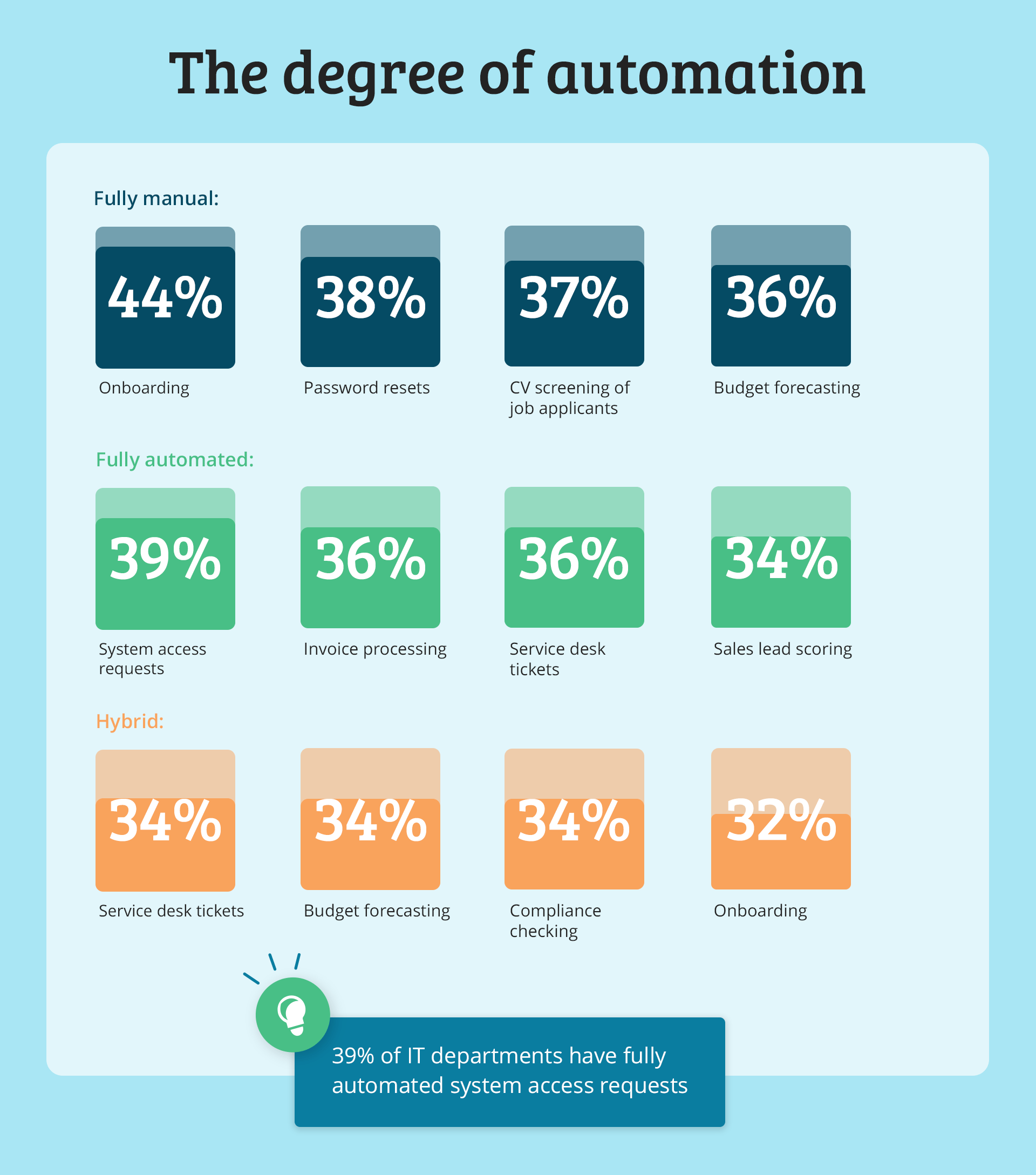
Our study shows that in most organizations IT automation is present, but not yet complete. The majority of the processes are reportedly in a hybrid stage where people and technology share responsibility. Room for improvement there, too. Because it can really transform how IT teams operate.
|
That’s why we stick to the old adage: automate what you can automate. And thanks to AI, the threshold for automation has been lowered immensely. Low-hanging fruit like password management and first-line IT support are the first tasks to hit with automation. (Applications that don’t support single sign-on in this day and age should really be phased out.) The beauty of automating things like password management, is that it immediately shows results in fewer first-line incidents. An employee who forgets their password no longer has to submit a service desk ticket, because an automatic password reset resolves it instantly. And that should be the goal: automating first-line incidents in such a way that there’s more room to structurally solve recurring problems. |
Positive about AI: improved productivity, decision-making and accuracy
Even though there’s more ground to cover, the changes already pay off – and IT teams across the UK are pretty happy about that. Younger IT professionals (ages 29-44) are even more likely to view the impact of AI positively (90%) than the older generation (ages 45-60, 73%).
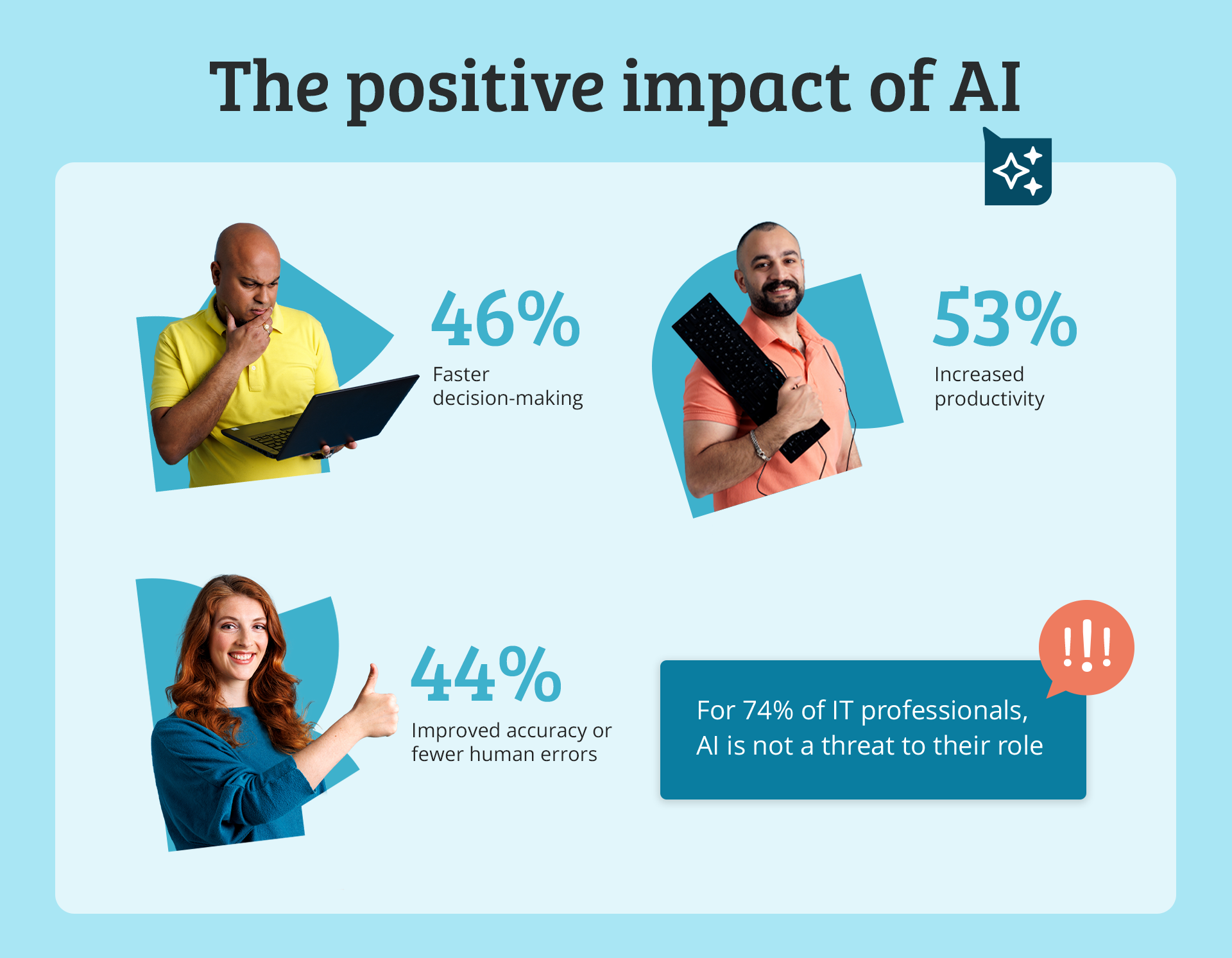
This positive outlook may also be explained by the fact that three-quarters (74%) don’t feel that AI is a threat to their role in the organization. More than eight-in-ten (85%) are actually enthusiastic about the future benefits of AI for their role or field.
86% believe that AI makes it easier to focus on the more meaningful parts of their job and that it helps them work more efficiently (87%). So, where is that impact delivered?
Respondents report increased productivity, faster decision-making and improved accuracy. Measurable changes that help your IT department improve incident management workflows and make your end users more self-sufficient.
 Concerns for security, control, employee support and ethics
Naturally, teams also have questions and worries around the introduction of AI and automation. The reported reservations mainly concern security and control, but also relate to employee support and ethics. Interestingly, according to Gartner, 59% of CIOs see the risk of hallucinations as the biggest concern around generative AI.
Despite these concerns, over eight-in-ten IT professionals (87%) do feel confident working with AI in their daily tasks. And that’s hopeful for the future.
Next up: is the British IT department ready for the future?
In the third and final blog of our 3-part miniseries, it’s time to look ahead. How confident are we about the future? How will AI and British IT professionals work together? And what does that mean for the role of the IT department within the organization? (Spoiler alert: things are about to change – for good.)
Read the previous article in this series:
Want to take a deep dive? Download the full AI and automation infographic here.
About the research
The findings in this blog are the responses from an international online survey conducted by Censuswide in August 2025 on behalf of TOPdesk. A total of 6,000 IT professionals participated, from Belgium, Germany, the Netherlands, Austria, the United Kingdom and Switzerland. All of them work in organizations with more than 25 employees.
This miniseries focuses on the responses of 1,000 UK IT professionals and their thoughts on AI and automation related topics specifically.
Inspire others, share this blog