How AI changes your service desk’s day – a regular Tuesday, upgraded
Your service desk operator’s day-to-day life is changing thanks to the introduction of AI. In this article, we’ll run through what a regular Tuesday might look like before AI, and then we’ll show you how to use TOPdesk Robin to improve the amount of time you have to work on the important tasks that require a human’s attention. You’ll understand how AI for service desk teams is ready to make a material difference to your service desk operator productivity.
How an average day at a service desk used to look
If you've ever spent a day around a service desk, you'll recognize Tom's day:
- 8:40am: Tom arrives at work with a coffee that's still too hot. It's Tuesday, so he's feeling fine.
- Just before 9am: He opens his laptop to find 41 tasks. At the top is one from Thomas, who's off sick. It's been open since last week and three people have already worked on it.
- 9:00am: Tom tries to work out where Thomas got to. The task has 20 comments. Half just say "still looking into it," which tells him nothing.
- 9:20am: He looks up and realizes he hasn't helped anyone yet.
- 9:30am: Sophie in Finance can't find the VPN guide. It's the fourth time Tom has had this request that morning. He can't just send a link, because it's Sophie's first time asking. So he writes it all out again.
- 11:00am: Claire's password has expired again. It's the third time this month. Tom now knows her dog's name and birthday.
- 12:30pm: A ticket arrives in German. Tom doesn't speak German. He uses Google Translate in a tab that's been open since 2021.
- Lunchtime: Fellow operator Rosa has a family emergency and her tickets come to Tom. Everyone says it's all written down somewhere. He grabs lunch from the vending machine and searches the knowledge base.
- Early afternoon: His search finds nothing. Rosa's team uses its own term for the problem. On the fifth try, Tom finds the article. It's two years old and the author has left.
- 4:45pm: His manager asks for this month's numbers. He'll need a week.
- End of the day: The queue has grown to 46, up from 41 that morning. Tom knows he fixed things. He just can't say what.
Days like these can feel hopeless. Every single task you had to complete yourself. Every answer you had to search for, sort, and write. You leave work feeling depleted like you’ve actually moved backwards; not forwards. In the rest of this article, we’ll show you how an ITSM AI copilot is going to change the game for your operators and end-users.
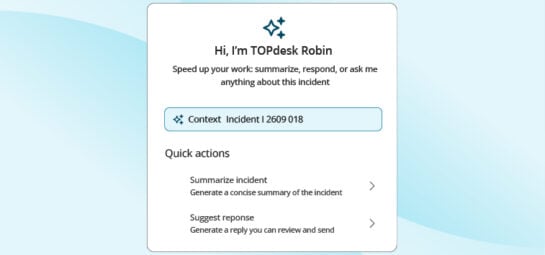
Introducing TOPdesk Robin: AI for service desk teams
As we’ve shown, yesterday, for every single ticket, you needed to search, sort and draft a reply by yourself. This is no longer the case thanks to TOPdesk Robin.
TOPdesk Robin amplifies your team. In practice, this means that it works alongside your team, inside of the places your team already works—in their service management platform. This means that operators benefit from all of Robin’s capabilities, without any additional friction.
Let’s take a look at some scenarios to see how our new service desk ai assistant, TOPdesk Robin, will help your service team.
Scenario 1: Nadia’s travel expense form
Nadia, a colleague of Tom, has travelled by train on a business trip, paying for the journey herself. She’s assuming she’ll be remunerated for the travel expense (it’s a business trip, after all), but she doesn't know the rule, policy or form for how to access the refund. So, she approaches the service desk.
Normally, Nadia’s first port of call would be to give a service desk operator a call. But today, she can get the help she needs with TOPdesk Robin.
TOPdesk Robin is located in the search bar in the Self-Service Portal—exactly where you might expect it to be. Nadia prompts Robin using the question she would use to ask her friend sitting next to her: ‘How do I refund my travel expenses?’. Nadia hits enter, and Robin begins thinking through the answer.
Nadia could have asked her colleagues sitting next to her. Maybe one of the people in the room had recently experienced the same issue, and knew how to resolve it. But there was also a risk that their information was outdated.
Assuming the knowledge, processes and data that make up the foundations of the AI’s inputs, TOPdesk Robin comes back with the information Nadia is looking for. It provides her with the information she needs to help her get to the right form, as well as instructions and important deadlines to make sure she complies with the rules.
TOPdesk Robin doesn’t guess. It knows that your team has already produced a knowledge item, and it knows where to look. Nadia can also check this information by clicking on it, allowing her to verify the source. Nadia can also see forms suggested. She spots the ‘submit payment claim’ form. She was actually looking for a ‘travel expense refund form’. Given the lack of any vocabulary overlap, no keyword would have been triggered, and therefore she wouldn’t have found the form herself. TOPdesk Robin, on the other hand, has all of the context to work this out and show the form to Nadia.
Scenario 2: Lena’s application error
Lena, another colleague of Tom, is seeing an error in a new application and doesn’t know what to do about it. Instead of calling the service team, she searches for the solution using TOPdesk Robin in her own language: German.
TOPdesk Robin comes back to Lena explaining that there isn’t an existing knowledge item for her request, and to file a new request with the service desk. A button appears in the conversation, allowing Lena to view an automated draft message to the operator including a summary and all the details for her to check.
Lena reviews the message, and realises that a piece of the puzzle is missing: she remembers seeing another error message. She adds in that context, and then presses submit. Before she submitted, Lena selected to check the ‘Include AI conversation’ button. The conversation history is useful context for the operator, but we recognize that some people might not want to show their full conversation history, so we leave the box unchecked on purpose. Lena gets her tracking number and she can track the conversation in the SSP as she would normally.
Scenario 3: The operator
Tom starts his day by checking open items, and sees the message from Lena. Unfortunately, Tom doesn’t speak German, but rather than use Google Translate or speak to a colleague, he can translate it using TOPdesk Robin.
He can now see the issue and can work out what to do to resolve it. Tom can also see a number of new items below Lena’s message in blue. These are AI suggestions. Tom can choose to accept these suggestions or not, and if he does, he gets useful additional context and hits save.
Tom’s now ready to start problem-solving. Using Robin’s AI ticket summarisation feature, Tom sees that there’s no existing knowledge item in the knowledge base to use to generate a response. So, Tom asks his colleagues what’s going on, and learns that Lena wasn’t granted access to the software.
He replies to Lena, explaining she’s been given access. He clicks the writing assistant, which gives Tom options to fix his typos and choose a style for the message: friendly, professional, etc., and then generates the reply and sends the message.
Tom now notices a second ticket from Emma. He checks the log and notices around 60 entries back and forth over a number of months. Rather than read them all, he chats with Robin to summarise the ticket, and highlight the main problem—which appears to be a VPN connection issue. So, he asks Robin to help solve the problem. Robin scans the knowledge base, and presents the knowledge to Tom. Tom copies the knowledge into his reply. He tops and tails the copied text with some further instructions to Emma. He notices that Emma is a senior manager, so he uses the writing assistant to change the tone to professional. Problem solved, so he resolves the ticket.
Conclusion
Compare the three scenarios above to the example of an average Tuesday at the start of this article. Hopefully, you can see how TOPdesk Robin could help breathe a breath of fresh air into your service desk operations, eliminating bottlenecks and improving service desk delivery. Start adopting our AI feature to improve your team’s workday. AI features not a part of your plan? Contact us.
Inspire others, share this blog