What is AI? And how does it impact service management?

Definition
Artificial intelligence (AI) is technology that performs tasks usually associated with human thinking, like recognizing patterns, understanding language, making predictions, or making decisions, by learning from data instead of following hard-coded rules.
In service management, AI handles repetitive work like ticket triage and routing, freeing your team to focus on the work that actually needs them.
Most of what people mean today when they talk about AI is generative AI: Tools like ChatGPT, Copilot, and Claude that generate text, code, or other types of content. Older forms of AI, like the machine learning behind spam filters or recommendation engines, work differently and don't generate anything new. Unless stated otherwise, what we’re talking about on this page refers to generative AI.
What AI does
Learns from large amounts of data to perform tasks such as generating text, code, or predictions based on patterns learned from data.
Why AI matters
Speeds up routine work, surfaces useful patterns, and frees your team to focus on more complex problems.
Where AI applies
Most knowledge work, including IT service teams, customer support, healthcare, finance, and software development.
What AI is also known as
- Artificial intelligence
- Machine intelligence
Where AI fits
AI is the broader field. It covers narrower technologies you've probably heard of, like machine learning, generative AI, large language models (LLMs), and natural language processing (NLP).
Why AI should matter to you
What AI means for your business goals
- AI makes it possible to do more without hiring more, especially for repetitive work that's slow, manual, or hard to scale.
What AI means for your business operations
- Operationally, AI handles things like sorting incoming requests, drafting responses, summarizing long documents, or spotting patterns in data your team would never have time to read manually.
Signs it's time to take AI seriously
Common triggers
- When your team is spending too much time on repetitive tasks that could be automated.
- When you're sitting on lots of data but struggling to get useful insight from it.
Bigger warning signs
- When competitors are clearly using AI to move faster, and you're not.
- When your backlog is growing despite people working overtime.
How AI works
AI systems learn patterns during training. Once deployed, most don't keep learning from new cases automatically, as this would require deliberate retraining.
That's the difference between traditional software and AI. Traditional software follows the rules a developer wrote. AI builds its own rules from the data, then applies them.
AI isn't new. The idea has been around since Alan Turing's work in the 1940s, and the term "artificial intelligence" itself was coined at a Dartmouth College conference in 1956. What's changed in the last few years is that the data, computing power, and models have caught up to what people were imagining seventy years ago.
There are different kinds of AI, but a few terms come up often:
Machine learning: the foundation. It's the process by which models learn patterns from data and improve over time. It's what's behind Netflix recommendations, your email spam filter, and the auto-suggest in your inbox.
Deep learning: more advanced machine learning. It uses layered networks loosely modelled on the human brain. It's what makes facial recognition, voice assistants, and image generation possible.
Generative AI: creates new content like text, images, code, and audio. ChatGPT, Gemini, and Claude are all generative AI tools.
Large language models (LLMs) a type of generative AI focused on language. They power most of the chatbots and writing assistants you'll come across.
Natural language processing (NLP): the wider field of getting computers to understand and use human language. It's what lets Siri or Alexa understand what you're asking for, and it's what lets a service desk system read a support ticket and figure out what it's about.
In service management specifically, AI usually shows up as a mix of these. A virtual agent uses natural language processing to understand the question, an LLM to generate an answer, and machine learning behind the scenes to keep getting better at it.
The four types of AI
Another way to think about AI is by what it can actually do. There are four broad types, and most AI today sits in the first two.
Reactive AI
Takes an input and produces a predictable output, every time. It can't learn from new situations or adapt. The Netflix recommendation engine is a classic example: feed it your watch history and it'll suggest something based on patterns, but it doesn't develop new behaviours over time.
Limited memory AI
Learns from recent data and improves its behaviour over time. Self-driving cars work this way, observing the speed and direction of nearby vehicles to make decisions on the road. This is the most common type of AI in production today.
Theory of mind AI
Theoretical for now. The idea is AI that can recognize and predict human emotions, beliefs, and intentions. We're not there yet.
Self-aware AI
The far end of the spectrum. AI with its own consciousness, self-awareness, and inner experience. Sometimes called artificial general intelligence (AGI). Decades away at least, possibly longer—if it’s even possible at all.
AI in service management software
AI in service management software isn't a single feature. It's a layer that runs across the platform, supporting the things service teams already do.
Common use cases include:
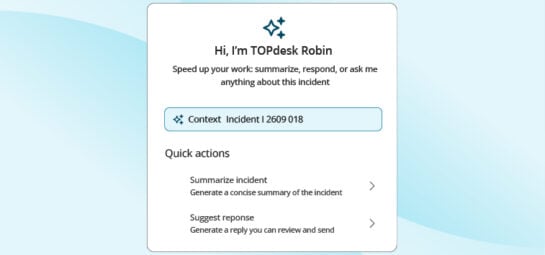
Ticket classification and routing. AI reads a request and assigns it to the right category and team, reducing manual triage.
Suggested responses. Based on similar past tickets, AI drafts a reply your agents can edit and send.
Knowledge base search. AI surfaces the most relevant articles for both end users in the self-service portal and agents working a ticket.
Self-service chatbots. Virtual agents handle simple, repetitive questions like "How do I connect to WiFi?" or "Reset my password." Users get answers instantly, any time of day, and your team doesn't get pulled into work that doesn't need them.
Cross-team workflows. AI-powered workflows can keep IT, HR, and Facilities in sync for onboarding and offboarding, so a new starter has everything they need on day one and access is revoked the moment someone leaves.
Reporting and pattern detection. AI summarizes ticket trends, flags recurring issues, and highlights problems that look like they're escalating.
Used well, AI gives service teams more time for the work that actually needs human judgement.
A practical example of AI at the IT service desk
Imagine your service desk receives 200 tickets a day. Without AI, an agent has to read each one, decide what category it falls into, and route it to the right team. It's slow, repetitive, and easy to get wrong.
With AI, the system reads the ticket, classifies it automatically based on thousands of similar past tickets, and routes it within seconds. The agent picks it up already in the right queue, with a suggested response and links to relevant knowledge articles.
The work still gets done by people. AI just removes the friction in front of it.
Common questions about AI
Is AI the same as automation?
No. Automation follows fixed rules you set up, and AI learns patterns from data and adapts. In ITSM, automation might route every password reset to the same queue, while AI reads a new ticket and works out which queue it belongs in. Most modern systems use both.
Will AI replace people?
Not in service management. AI is much better at repetitive tasks than at handling messy, unusual, or sensitive situations. The teams getting the most out of it use AI to handle the volume and keep people focused on the work that needs them.
Is AI always accurate?
No. AI can get things wrong, especially when it's working with data it wasn't trained on, or when the question is ambiguous. That's why it's important to keep humans in the loop on anything that affects users.
What's the difference between AI and machine learning?
Machine learning is one type of AI. AI is the broader category that also includes things like generative AI and natural language processing.
What's an LLM?
A large language model. It's the kind of AI that powers tools like ChatGPT. LLMs are trained on huge amounts of data (images, audio, video and text) and used to generate or understand language.
Do I need a data scientist to use AI?
Not anymore. Most modern tools, including ITSM software, build AI into the product so you don't have to design or train models yourself.
How safe is it to use AI with company data?
It depends on the tool. Look for clear documentation on where data is processed, whether it's used to train models, and how it complies with regulations like GDPR.
Your next read
Inspire others, share this blog